Real animal facts
Octopuses
are wild.
Octopirate isn't just brave. He's biologically one of the strangest, smartest creatures on the planet. Real octopuses are even cooler than the books make them sound.
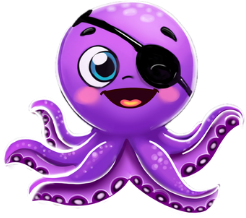
Octopirate isn't just brave. He's biologically one of the strangest, smartest creatures on the planet. Real octopuses are even cooler than the books make them sound.
(All real. We checked. Some of them sound made up.)
This one is the wildest. Octopus suckers are covered in chemoreceptors, the same kind of cells that line your tongue. They literally taste whatever they touch. So when they reach into a crack to feel for a crab, they're also tasting the crab to know if it's worth eating.
Two hearts pump blood through the gills, and a third pumps it through the rest of the body. The blood is blue because it uses copper-based hemocyanin instead of iron-based hemoglobin, much better at carrying oxygen in cold, deep water.
Octopuses have a central brain plus a smaller bundle of nerves inside each of their eight arms. About two-thirds of their neurons are in their arms, not their head. Each arm can solve simple problems on its own, even when the central brain isn't paying attention.
Tiny color-bearing cells called chromatophores let them shift color and pattern in milliseconds, faster than you can snap your fingers. The truly weird part: octopuses are color-blind. Scientists still don't fully understand how they match colors so perfectly.
The veined octopus carries two halves of a coconut shell around like a portable bunker, clamping them shut when danger appears. Other octopuses have been seen using rocks to wedge clams open. Tool use is extremely rare in invertebrates.
The mimic octopus can impersonate at least 15 different sea creatures (sea snakes, lionfish, jellyfish, flounder, even seahorses) by changing both color and the way it moves. It chooses which animal to mimic based on what predator is nearby.
Octopuses can squeeze through any opening larger than their beak, the only hard part of their body. Aquariums have had octopuses unscrew jars from the inside, lift tank lids, walk to neighboring tanks at night to snack, then walk back. Yes, walk.
Octopuses can briefly leave the water and crawl across rocks or even sand to reach a new tidepool. The Indonesian veined octopus has been filmed walking on two arms for stretches, like a tiny purple sea-cowboy.
To escape danger, they suck in water and blast it back out through a siphon, shooting backward at speeds estimated up to about 25 mph in short bursts. Many also release a cloud of ink that confuses predators and dulls their sense of smell.
Sleeping octopuses cycle through colors and twitches that look a lot like our own dream-stage sleep. Scientists think they may be running through memories of hunting, fleeing, or just being an octopus. Imagine those dreams.
Their eyes can see polarized light, a kind of "extra dimension" of light that humans can't perceive. That's how they spot transparent prey, like jellyfish, that would otherwise be invisible.
Most octopuses live only 1 to 5 years. Mothers usually stop eating to guard their eggs until they hatch. Then their job is done. They pack a lot of cleverness into a short life. (Octopirate is determined to make his count.)
The big challenges they face in real oceans:
Octopuses are sensitive to temperature. Rising ocean heat can disrupt their breeding cycles and shrink the range of species like the giant Pacific octopus.
Octopuses sometimes use plastic trash as shelter, but it's a poor substitute for natural dens, and they can ingest microplastics through prey.
Octopus is increasingly caught worldwide for food markets. Global catch has more than doubled since the 1980s. Many populations of common octopus and others have shown sharp declines, and most octopus fisheries still have no sustainability rules at all.
The world's first commercial octopus farm is being developed in Spain, with plans for ~3,000 tons a year. Octopuses are solitary, highly intelligent, and sentient (the UK officially recognized this in 2021). Crowding them into tanks is widely opposed by scientists and animal-welfare groups. Never eat farmed octopus, avoid wild-caught octopus whenever possible, and tell your representatives that octopus farming should be banned before it scales.
Small things that really do add up.
Use a refillable water bottle, skip plastic straws. Octopuses sometimes use trash as shelter and deserve better dens. Take the Plastic Free challenge for a simple starter habit.
Before buying octopus or fish, check the MSC blue label or look up the species in Monterey Bay Aquarium's Seafood Watch.
Tell stores and restaurants you will never buy farmed octopus, and skip wild-caught octopus whenever you can. Sign petitions opposing octopus farming with Compassion in World Farming or Aquatic Life Institute.
Walk, bike, and go without meat as much as you possibly can. Eat mostly plants. Measure your starting point with the EPA Household Carbon Footprint Calculator and pick wins from Project Drawdown.
Octopus protections (and bans on commercial octopus farming) need political pressure. Use 5 Calls to phone your reps in 5 minutes about ocean issues.
The more people love octopuses, the more people protect them. Share a fact with a friend today. (Three hearts is always a crowd-pleaser.) Watch My Octopus Teacher as a family.
Real octopuses inspired a story about real conservation, wrapped in a kid-friendly adventure.
🐬 Next: Meet the dolphins → 🐙 Pre-order Octopirate Save the Reef →