Real animal facts
Sea Turtles
are time travelers.
Professor Shellby's real-life cousins swam alongside the last of the dinosaurs, navigate the open ocean by magnetic field, and somehow always find their way home.
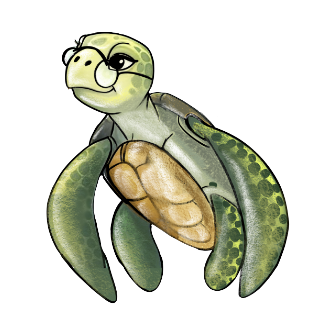
Professor Shellby's real-life cousins swam alongside the last of the dinosaurs, navigate the open ocean by magnetic field, and somehow always find their way home.
All real. All cool.
Sea turtles navigate by reading Earth's magnetic field. They learn the unique magnetic "address" of their birth beach as hatchlings and use it to find their way back decades later, across thousands of miles of open ocean.
Sea turtles have been swimming the planet for around 110 million years. They shared the ocean with marine reptiles like plesiosaurs and outlived the dinosaurs by 66 million years. They are one of the oldest creature designs still alive today.
Loggerheads and green turtles can live 70–80 years; some species are estimated to live 100+. A turtle hatched today could still be swimming when today's babies are grandparents.
A female sea turtle lays around 100 eggs in a single nest, several nests per breeding season. Only about 1 in 1,000 hatchlings survive to adulthood, so every nest matters.
Leatherback turtles routinely migrate over 10,000 miles in a year, across entire ocean basins, to follow their favorite food, jellyfish.
Whether a hatchling becomes male or female is decided by the sand temperature where the egg is buried. Warmer sand → more female hatchlings. Climate change is starting to skew this dramatically.
Sea turtles drink saltwater. They have special glands near their eyes that pump out the extra salt, which looks just like crying. So when you see a nesting mom "in tears," she's actually just well-hydrated.
Green turtles eat mostly seagrass. They're the lawnmowers of the reef. Hawksbills eat sponges that nobody else can stomach. Leatherbacks eat jellyfish. Each species has its own job in the reef.
Female sea turtles return to lay eggs on the very same beach where they were born, even if they haven't been there in 30 years. Scientists still don't fully understand how.
Their shells are streamlined for ocean swimming (not like land tortoises). They can dive over 1,000 feet deep and hold their breath for hours when resting.
All 7 species are threatened or endangered.
To a hungry sea turtle, a floating plastic bag looks identical to a jellyfish. Many turtles die from intestinal blockages caused by eating plastic.
Bycatch in commercial fishing gear is one of the leading causes of turtle deaths worldwide. Turtles get tangled and can't reach the surface to breathe.
Hatchlings instinctively crawl toward the brightest horizon (normally moonlight on water). Bright beachfront lights confuse them and lead them inland to die.
Simple things that genuinely save lives.
Plastic bags are turtle enemy #1 (they look like jellyfish, a turtle staple). Switch with the help of Plastic Free challenge's starter checklist, and pick up plastic on every beach visit.
If your family visits a nesting coast (Florida, Costa Rica, Mexico, more), turn off porch lights and use red flashlights. Florida FWC's sea-turtle lighting guide explains why.
Released balloons end up in the ocean and look like jellyfish too. Read about the Balloons Blow campaign and pick a different way to celebrate.
Symbolically adopt a tagged turtle and follow its migration online with Sea Turtle Conservancy or Oceanic Society. Donations fund tracking, rescue, and nesting-beach protection.
"Tortoiseshell" jewelry is real hawksbill shell, and hawksbills are critically endangered. WWF's illegal wildlife trade page shows what to spot and how to report it.
Coastal families can volunteer overnight with Sea Turtle Conservancy's nesting program in Costa Rica/Florida, or join local hatch-watch chapters. Search "[your state] sea turtle volunteer."
The wisest, oldest character in Octopirate's reef, and one of the most threatened in real life.
🐠 Next: Meet the reef fish → 🐙 Pre-order Octopirate Save the Reef →